Paula A. White and Daniel Talmo
In July, 1999, 45 participants from six countries including Canada, Hong Kong, Hungary, New Zealand, Switzerland, and the United States embarked on a unique music and dance tour to Transylvania. The tour lasted ten days, starting in Budapest and traveling to Romania by bus, with several stops in Kalotaszeg, Mezöseg, and Székelyföld villages. The tour organizer, Kálmán Magyar from New Jersey, and hosts from the various regions made arrangements for home stays, sightseeing, and music and dance parties. The tour offered many opportunities for cultural exchange, with participants joining local villagers in home life, church services, and village rituals.
Tour participants represented a variety of professions including engineers, artists, medical professionals, legal assistants, researchers, and students. In addition, a wide variety of ethnic backgrounds were represented including American, Chinese, Croatian, Czech, German, Polish, Slovak, and several who were born in Hungary and Transylvania but had emigrated to Canada or the U.S. The age of participants ranged from 11 years old to retirement age, but the majority of the participants were middle aged (30-45). All of the participants had a wide variety of hobbies but most shared a special interest in Hungarian music, dance, and culture. The total cost of the tour was $500 (U.S.) including meals and accommodations but not airfare.
During and following the tour, we interviewed tour participants and distributed questionnaires to gain insight on why folks wanted to go on the tour, what they encountered and learned, and to highlight the unique aspects of the trip. What follows is a summary of the responses of over half of the tour participants (26 of 45) to nine questions. The responses were overwhelmingly positive about the trip. Not all participants responded to each question. A representative sampling of the responses is provided here.
1. Why did you want to go on this trip?
I went on this trip because I am very attracted to Hungarian music and dance. I have attended some of the Hungarian folk dance Symposiums in Enon Valley, Pennsylvania and wanted to go and see first-hand what the dances and people are really like. I felt that it was a once-in-a-lifetime opportunity that I couldn’t pass up.
Never having been there before, we wanted to see Transylvania at least once in our lifetime. This gave us that unique opportunity. We also heard that the natives have the best pálinka (plum brandy) on earth!
I never learned anything about Transylvania while in Hungary, in fact, it was never taught to us that Hungary lost two-thirds of its territory in 1920. While in Canada, I learned the “true” history of Hungary, and also learned folkdancing including Tranyslvanian. I found the Transylvanian history and folk culture to be very interesting and I wanted to visit some of those places that Hungarian history writes so much about. When I saw the advertisement for the tour, I knew I could not miss this chance.
This was my first visit to Hungary in 55 years, my purpose was to reconnect with my roots and also to personally experience and deepen my knowledge of folk culture and folklore and to be with the people in the villages.
To see how the villagers live, work, and maintain traditions; to take pictures, make video and audio tapes of the real thing; to dance with the villagers; to finally see Szék; to buy folk costumes.
To benefit from the opportunity to visit Transylvania in a cultural/folkloristic viewpoint and to get acquainted with Transylvania in that sense, because during Ceaucescu’s regime promoting Hungarian cultural identity was greatly restricted thus I had very limited experience in this sense.
I am very interested in Hungarian and Romanian folk dancing. My main reason for going on this trip was to learn more about Hungarian folk dancing and to see how it is really done in the villages. I believe that Transylvania is one of the few places left where traditional ways of life (including folk dancing) are still preserved.
2. What expectations did you have?
I expected to see village life and meet families and hear lots of music and do some dancing with the local bands, also to see some scenery and to get up into the mountains a bit.
I expected to experience the culture through immersion; to dance; and to get to know the people and their customs, lifestyles, and beliefs.
My main expectations were to see and learn Hungarian folk dancing as it is done in the real villages.
We went into this trip with mixed emotions. We knew that the entire region is very poor and fell behind the times beyond their control. We also knew that the people would welcome us with their open hearts and minds as we visited the ancient Hungarian villages. These are our people, our sisters and brothers from day one in our history.
Economically, I knew that Transylvania was in a lot poorer condition than Hungary, therefore I expected very poor people. However, it seemed to me that Transylvania’s infrastructure was in a poorer condition than the people. Politically, I expected very high tensions between Hungarians and Romanians, but it turned out to be less frictional as I talked to the locals. The tension is still there, but it seems to be an excepted part of life. Environmentally, I expected Transylvania to be very beautiful as I have heard it was from friends and my readings.
To be enriched by whatever experience our travels offer and to gain a deeper understanding and appreciation for the diversity of our people.
I did not expect such a large-scale welcome and support for our visit by our guest towns and villages; thus my expectation was a low profile one.
That we’d be really tired by the end of the trip. Lo and behold, I was right. But seriously, I expected I’d see a lot of the behind-scenes lives of the people who created the music and art that I love so much – where and how they live, but also that we’d do some sightseeing as well.
3. What did you learn (key items)?
That the people were as curious about us as we were about them especially in Buza and Szászcsávás – very inquisitive about our quality of life, relationships, jobs, and reasons for going on the trip.
I learned a lot about the current political situation and beliefs of the people from the families that I stayed with. I learned customs and some new dances. But most important to me, this trip has brought me to understand my grandmother in a new light. To see places similar to where she is from and to realize why she does things a certain way, values different things than me, and holds certain beliefs, were the most valuable lessons I have come away with.
It was a very revealing experience. The poverty sticks out, how poor the people are and how they manage, how they are still able to eat and have housing and take care of themselves even though they are so poor. I guess the reason they make it through is they have a deep sense of community. They all help one another out, they know one another and they work together in the village.
I learned a bit about the folklore. It’s still thriving in many places. It’s definitely changing.
People are people everywhere. There is a great need to offer assistance to those people where we were if we want them to preserve their national identity and folklore. We may appreciate their folklore more than they do themselves. People responded to us better than I thought they would; they opened their hearts and homes to us, much more than I expected. The folklore we learned here was “genuine,” in other words we felt at home dancing and singing with local folks from Mezőség, Szék, Székelyföld, Szászcsávás – sometimes I felt I was at the Symposium in Pennsylvania.
The beautiful music and dances of Transylvania are beyond imagination. We learned a lot of the various historic places during our ten day trip. We also made quite a few new friends, including the 45 marvelous people on the bus from around the globe!
Transylvania is a very beautiful part of the world – an unexplored, yet unrealized treasure. I learned some first-hand experience of the everyday life of the people. The village people’s standard of living is not as bad as I thought it would be. The villages where people had trades such as hat-making and their own shops, were even better off than those villages that mainly relied on farming.
We (Transylvanians) are a people of great hospitality in spite of many hardships, people are faith-filled, hopeful and industrious. There is a genuine desire to celebrate life.
I found that despite the everyday hardships the village people face each day, they are very loving, caring and sharing individuals. I did not think that such a strong bonding between our hosts and us would be possible in so little time. Our departures were always emotional and tearful.
That struggle for cultural survival of Hungarians in Transylvania keeps Hungarian heritage alive and slows down the trend of adopting western values.
That television from Hungary through cable and satellite networks is already in the small towns and the junk from America helps to destroy these folk customs and cultures.
When I used some Romanian, I was corrected in Hungarian. I was surprised at so many Hungarians in the towns, villages and cities of Transylvania (originally I thought they’d be mostly Romanian).
Better Hungarian language skills; new dances; new perspective on what my life means vis-a-vis the villagers: Their life is not “mobile, ” mine is. Barring some extraordinary luck and effort, not to mention burning desire, they will most likely remain close to their roots, which are very rich, but circumscribed. As a mutt American, I don’t have one single, huge cultural inheritance handed to me; on the other hand, I have a smorgasbord of options unavailable to a Transylvanian villager. The very phrase “lifestyle choices” is foreign to that world. Their identity is ingrained and their paths are, to a large extent, laid out. I sense a huge emptiness in my own country — it’s the Zen emptiness of potential, which unfortunately tends to depress many Americans…In Transylvania I really began to think about how I neglect my own freedom; my own potential glared at me. My travels both exhausted and elated me. Since returning, I have renewed energy and sense of purpose.
I value the opportunities to see and to appreciate people’s ways of life, their love of music, dances and songs.
4. What did you like the most?
Neti’s playing.
The people and their generosity and honesty. They look you straight in the eye and they’re truly interested in you and what you have to say.
Dancing with the locals in Szék and Szászcsávás and staying with the family in Szék and the beautiful scenery.
I liked going to villages, meeting people, and staying with families. The most exciting thing is to actually be in their living room, have dinner with them, and talk to them about life. That’s the ultimate experience.
I thought the trip was fantastic! I liked staying with families, the food, the dancing, the shopping opportunities, and the performances.
The food was excellent.
Our guides and our hosts were giving their most – they were beyond my expectations.
The people, the music, the dances, the countryside, the hospitality, the food.
The variety of villages, their folk art, traditions and countryside.
Overall, it was the environment that was the most beautiful. I really enjoyed our exposure to the folk art, the dance houses, and the history of the villages and towns we went through or visited. I really enjoyed my first-hand conversations with the locals about history, politics and what is it like to be a Hungarian living under foreign control.
The welcoming nature of all the people we came in contact with both in Hungary and Transylvania.
I loved the music and anything to do with the forests.
I enjoyed most the opportunities to stay in village houses and going to the táncház. The hosts were very kind to us. Though my original expectations were mainly of folk dancing, I also liked the other things included in the program, for example, it was good to go to do some shopping and swim in the salt lake. The concerts at the Salt Mine Theatre and the children choir were great.
It was wonderful to dance with the male dancers from the villages. They were the best partners I’ve ever danced with.
I hope to go back with my kids in about two years. I really enjoyed Szászcsávás – a very unique village. I found that I could appreciate the places if we stayed longer as in Méra, Szék, and Szászcsávás. Getting to know the people is so much a part of touring places like that.
5. What did you like the least?
The outhouse setting.
Poverty.
The long bus rides – we should have stayed longer at each place, but we needed to stick to our plans.
The disco in Szék. But I suppose they have to have it. I can’t expect them not to change. Also, I didn’t like all the garbage I saw in the streets in Szék.
I would have liked to have seen some Romanian dances and culture as well, the trip focussed almost entirely on Hungarian dances and culture, but after all, we were in Romania.
The only thing that I didn’t like is that I felt that we were rushed many times when I wanted to spend more time at a place – but that’s the way touring with a group is.
There is nothing I disliked. I would only have hoped that the air conditioner in the bus was better so that we could have a better rest while on the longer trips and could recover our energy quicker.
I do not have any complaints! I was very satisfied with the tour!
6. What kinds of cultural distinctions did you observe (compared to home)?
Life in Transylvania is simpler, but more difficult at the same time. Most people own a horse and carriage, some livestock, and have a farm. Many don’t have telephones or televisions and thus do not feel the stress of the world that these communication links often create. They never worry about being on time or late. But, then, they fear the stability of their country, the economy, their status as a minority group. I noticed that parents spend more time with their children there than in the U.S. and that there is a greater sense of community than where I live. People rely on what they can make and do for themselves. Men and women (especially) age faster and harder. But in many villages I noticed a greater respect for the elderly than I have in the U.S. It was ironic that we were searching for a culture that the young people [in Transylvania] were trying to lose, throw away, and forget about.
They have a deeper sense of community. Prejudices persist. We stayed with Hungarians and they had strong dislikes of Romanians in general and the Romanians had dislikes of the Hungarians. Neither care much for the Gypsies. They don’t invite the Gypsies to the táncház or into their society. My Hungarian host from Szászcsávás had never walked to the Gypsy neighborhood. Women were very subservient. In some ways I saw some real positive cultural aspects such as cooperation, but I also saw prejudices, hatreds, and lack of equal rights and equal respect across peoples.
One of the most interesting distinctions I noticed between the West and Transylvania was the issue of equal rights. This was most noticeable with the treatment of the Gypsies in Szászcsávás. We walked through their village taking pictures and watched them dance and play on the gazteto (the hill in the village). But then that night, as we had a large reception in the culture house (with their relatives supplying the music!), they were not allowed to enter.
People in Translyvania are closer to nature and produce their own food in most cases. They stick together and know how to live with/near each other even if they have arguments. They envy us for what we have and what we do, and we envy them. The hospitality we observed cannot be duplicated in America. The biggest difference: less palinka in the U.S. (except at the Symposiums).
The people of Transylvania have preserved their Hungarian cultural heritage, including the language! This is truly amazing, considering that they have lived for the past 79 years under Romanian rule.
That dance is a natural part of their normal life, while for us it is a hobby.
Some of the small towns grow their own food that is superior to anything we can buy in our supermarkets.
People went out of their way to accommodate us, giving us the best room in the house, presents, and three-course meals – especially when they have very little.
Our health care isn’t the best in the U.S., but the poor people in Transylvania really have problems in this respect.
Although theirs is a physically harder life, though more flavorful, I saw no feeble people there. Even the elderly were vigorous. By the end of the trip I suspected that our privileges in America enslave us to an extent.
It is generally assumed that one is either Catholic or Protestant; sometimes Unitarian; but never a Pagan or an Atheist, for example.
Sex roles were rigid, but each individual seemed to use them to his/her advantage. The cultural divide between Roma and Magyar struck me as similar to that between African-Americans and whites circa 1920.
7. What kinds of distinctions did you notice in the villages, compared to your previous knowledge of Hungarian music and dance?
The singing style in Szászcsávás.
Much of the Hungarian music and dancing that I learned previously was almost exactly the same as what I watched and actually did with the people. They just do things a little bit slower. Everything on the whole seemed more relaxed – but then again, I have always learned dancing for the stage.
People dance the way we learned, but they do it in a much more relaxed and simpler fashion.
The dances were done more simply. Some of the kids dance whatever they feel like. We learn dances very rigorously, focussing on lots of sequences and timing, very structured, very rewarding. But in the villages, it’s a lot simpler, whether you’re on the beat or on the inside or outside foot isn’t as important, whether you know a lot of figures isn’t important, only the basic structure of the dance seems to be similar to what we do here. There it’s a living tradition. It’s not important how well you know the dance or how many figures you know. Here it’s important, it’s in our revival movement to study all the figures and learn all about the dance.
I think live music and local people’s involvement in their own indigenous folk culture is less than I have seen in my last trips in 1976 and 1983. This is due to mass media (see the TV antennas?) and more travel by the people. We cannot and should not stop or limit it, we should assure they treasure and respect their own culture.
With the passing of years, traditions and their art are slowly dying away. There was a time when the entire village would sing, dance and participate in celebrating events. Now there are few who can still remember or preserve the rituals. The number of youths in the villages has declined dramatically.
I feel that our previous knowledge was fairly representative of what actually takes place today.
I was actually pleasantly surprised that the music and the dance was very much like what I heard and learned in Canada. Then again, our dance group learned the dances from video tapes from the Budapest and Kodály Ensemble of Hungary. It was really great and sort of a surprise to hear the local bands play the same songs that I heard on tapes, and to do the same steps we learned. There is of course a big difference in how confidently we danced compared to the locals. I found there is a big difference in knowing a set of dances well, and being able to instantly pick up on any dance or step. Being able to dance a set of dances well is a great achievement, but being able to freely dance to any rhythm is a lifetime learning experience.
That the young people dance disco and only the middle-aged still have the folk dance (with some exceptions).
Village dances are less formalized and less intricate than that which we are taught. I think this is to be expected, since I think that which we learn are highly stylized and performance-oriented.
Compared to my previous knowledge, there were no glaring surprises.
I think the older people dance in a much more relaxed style in the villages, perhaps because of their ages. The women are more passive; the men enjoyed leading the women and doing the show-off steps. The Gypsy dances were also very interesting.
8. What recommendations do you have to improve the trip?
I really have no recommendations except for avoiding restaurants in Romania and bringing toilet paper.
Spend less time on the bus. Go to fewer places.
Invest in a good camera and bring lots of film.
Visit only one village a day!
I would have liked another night in Szék, it was too short of time there.
Do not do it too often – be sure not to exploit or do not allow anyone to exploit the good nature of the village folk.
It was a well-planned and organized trip, not much was left for chance. I hope we can do it again some day.
I really do not know how the trip could have been made better. It was extremely well-organized, I really cannot complain that I did not get my money’s worth. One mistake I found annoying is that we went through Székelyudvarhely just to eat, then the next day or so, we went back because the mayor had invited us. The gesture was nice and important, but it would have been even better if we actually toured the city a bit.
Stay longer in a given area, limit the number of the group.
Slow down a little and spend more time in each place.
Avoid hotels, since staying with village folks gives a greater depth to the experience.
More shopping time (maybe a three hour option in Korond for example), one chance to change travellers’ checks (best timing would be just before mid point of trip), a restaurant dinner stop on return trip. Also, encourage trip participants to dance a little with us anxious but less-experienced dancers.
Less bussing; more unscheduled time (though I realize there were limits and choices to be made — but as long as we’re wishing).
Hire a better air-conditioned bus. It would be good to have a more detailed daily itinerary with routes and destinations shown on a map so that we all know where we are going and what places we are passing through.
9. Anything else you’d like to add that you think is important?
In thinking back on the trip and my reactions during it, I keep wondering about attitudes that kept coming up again and again – Hungarian and non-Hungarian. This includes a lot of negative attitudes towards Romanians and most telling to me was that last night in Szászcsávás when the Gypsies including wives and children of the musicians that we had come to hear could not come in and hear the music and be a part of the festivities. I heartily recommend discussion of multi-culturalism, respect and tolerance for others as well as valuing and preserving what is one’s own. The trip leaned on the latter almost to the exclusion of the former. It helped me understand the Balkans, ethnic cleansing and the dynamics that seem to keep different peoples apart and often at odds. I don’t know if anyone else had this reaction, but I certainly did. The trip kept touting the diversity within the group itself but that was quite superficial.
The people on the trip were absolutely fantastic. Everyone understood the difficult times and I think they also understood the beautiful moments of the trip. Furthermore, everybody seemed very sensitive to the people who opened their heart and homes.
We were “pioneers.” I did not realize this until the middle of the trip. No one ever attempted to do what we did. It concerned me a little, but I think our trip ended up to be very supportive and very positive to enforce local people who are involved in maintaining the community and the local village culture. I was concerned that we would cause an imbalance in those fine community structures. As it happened, I think we left no damage behind, it was due to the fact that we appreciated what people offered to us and did not criticize anything we were offered. We reinforced their way of life, this was the most important – we not only received, but we also actually gave some of ourselves.
Only that the trip for me was truly a lifetime experience that cannot ever be repeated the same way. I thank the tour organizers and everybody who came and made the trip so wonderful.
Having fewer people on the trip would be a good idea, if it could still be economical for the organizers to pull it off.
The trip was excellent and it’s a big credit to Kálmán Magyar and all the organizers. It really was terrific!
I liked the trip very much. Everything was so well organized. If we went to these places ourselves, we wouldn’t have such a nice program. The main drawback was that we couldn’t speak or understand Hungarian. Nevertheless, we enjoyed the trip.
I think it is important to celebrate some kind of communal event or seasonal holiday if at all possible. This reinforces the preservation of traditions and rituals that in turn give cause to celebrate our identity in life. The baptism in Méra was a great example.
It was really great to be with such a diverse group and to be able to share each of our experiences.
A phenomenal trip, packed with all kinds of experiences, adventures, cultural participation, wonderful people, and wonderful trip participants.
I think an important thing was the interaction among the participants. There are differences among us of course; but overall it works out generally OK. We are not and do not want to be just a bunch of participants each going on our separate vacation trips; we are really a group and it was interesting and important to us how we interacted with each other, getting to know something about and helping each other.
Summary
Based on feedback from participants, the Transylvanian tour was overwhelmingly successful. The primary motivation for participants to go on the trip was to learn more about Transylvanian dance, music, and culture. In some cases participants were motivated by the desire to practice Hungarian and to learn more about their ethnic heritage but also to experience Transylvanian village life first-hand.
While many of the participants indicated that they tried not to have any expectations before taking the trip, several indicated that they had hopes of getting better acquainted with Transylvanian folk culture. In many cases, reality seemed to exceed expectations in terms of the friendliness and hospitality displayed by the host families during the homestays.
It is clear that the trip encompassed a wide variety of learning experiences. Descriptions such as “a very revealing experience” and “beyond imagination” make it apparent that the overall assessment of the experiences were positive. Participants not only learned about the politics, economics, customs, and dances of the area, but also developed a strong bond with the people in the villages.
Favorite aspects of the trip were the music, dancing, and homestays with families. In addition to the items identified in the quotes above, other notable highlights of the trip were the wedding anniversary ceremony in Szászcsávas with an outstanding choral audience and party, the children’s orchestra in Szenkereszbánya, the mountains of Bicaz, the salt mine performance in Parajd, the salt water lake resort in Szováta, the reception and party in Buza, the houses in Szék, the dance and music in the Szászcsávás Gypsy village, not to mention the young farmer that mooned the bus while we were driving outside of Buza.
Several respondents could not think of anything about the trip they did not like. The two least favorite aspects identified by tour participants were the toilet facilities and spending too much time on the bus. Some found it inconvenient that they did not speak Hungarian, but participants indicated that despite the language barrier, their hosts expressed interest in them and welcomed them. Participants also indicated that it was uncomfortable to observe villagers living in poverty conditions.
The most common cultural distinctions identified by participants were the overwhelming generosity and sense of community on the part of the villagers. In addition, participants identified distinctions between the West and Transylvania in terms of sex roles and equal rights. A couple of respondents did not notice significant differences in what they knew previously about Hungarian music and dance compared to what they saw in the villages. However, several pointed out that the dances done by the villagers are simpler and less stylized and that the villagers dance in a more relaxed fashion.
While responses indicate that participants were overwhelmingly pleased with the trip, a few helpful travel tips were made
- Bring your own toilet paper
- Invest in a good camera and bring lots of film
- Don’t expect a Caribbean-style vacation
In addition, a few recommendations and suggestions for improvement were made
- Spend less time on the bus
- Allow for more shopping time (especially in Korond)
- Provide more unscheduled time
- Spend more time in fewer places
- Provide a detailed daily itinerary
- Provide improved hotel accommodations
- Limit the number to fewer people on the trip
- Offer the tour again but not too often
Finally, tour participants identified a persistent tension that exists in the relationship among Hungarians, Romanians, and Gypsies. This relationship was not openly discussed by the locals nor easily understood by participants on the trip. While more time is needed to try to build a better understanding of these cultures, this trip fostered a deeper understanding of the region by participants and served to build closer bonds across cultures, dances, and music. Not only the interactions between tour participants and villagers, but also the interactions among the participants themselves, were valuable in sharing information and creating lasting memories that will have a long-term impact.
Itinerary
Day 1: Following a táncház the night before with a dance workshop by Zoltán Zsurafszky and music by the Ökrös Ensemble, travel from Budapest to Opusztaszer National Park in Hungary and arrive late in Méra, Transylvania.
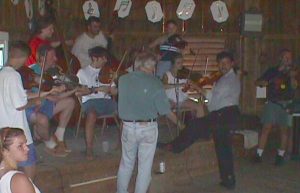
Day 2: Visit Kalotaszeg villages of Inaktelke, Körösfő, and Bánffyhunyad. Attend christening and Gypsy wedding in Méra followed by a táncház to the music of the local band with Neti Sanyi Bacsi.
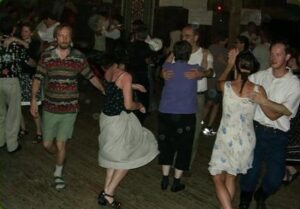
Day 3: Visit Kolozsvar and travel to Szék through Bonchida. Attend evening táncház in Szék to music of local musicians.
Day 4: Travel through Mezöseg to Szováta with a visit in Buza, and participate in afternoon táncház. Travel on to Parajd.
Day 5: Visit the village of Korond, famous for its pottery and folk art. Stop for lunch in Székelyudvarhely and attend evening performance and táncház in the salt mine theater of Parajd.
Day 6: Bathe at a salt lake in Szováta. Attend children’s choir concert in Szentkereszbánya followed by an evening táncház at the Szekelyföld dance camp in Felsősövalva.
Day 7: Visit the Gyergyó mountains and picnic with live music near Liban followed by a táncház in Felsősövalva.
Day 8: Visit Marosvasarhely, the capital of the Székely region and attend evening táncház in Felsősövalva.
Day 9: Travel to Szászcsávás and meet with local musicians, singers, and dancers. Attend church ceremony and evening dinner and táncház with music by the Szászcsávás band.
Day 10: Bid farewell to the Szászcsávás hosts and return to Budapest through Southern Transylvania.