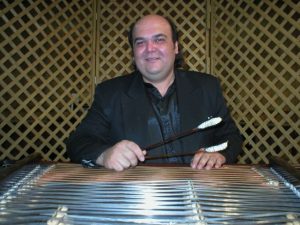
Pushing Gypsiness, Roma or Otherwise
Michael Beckerman, The New York Times
Michael Beckerman, The New York Times
Michael Beckerman, The New York Times Michael Beckerman, The New York Times On the winding roads of Arizona, near places like Kingman, the birthplace of the cowboy comic Andy Devine, there are signs everywhere for “Indian jewelry.” People in the cities may speak of Native Americans, and for all I know, the purveyors of turquoise and silver think of themselves as such. But selling is selling, and the word “Indian” is considered more likely to pull in traffic. So, too, the word “Gypsy.” For years, it has been clear that most members of this group prefer to be called Roma (sometimes spelled Rroma, to ensure that the “r” is rolled). But selling is selling, so the word “Gypsy” crops up, whether in the trailer for the film “Latcho Drom,” on the many CD’s with a “Caravan of the Gypsies” theme or at a local restaurant advertising its romantic violinist. Or in connection with events to take place this week and next at the 92nd Street Y: two exciting programs titled “Familiar Strangers: The Gypsy Musical Heritage.” The first, on Thursday, offers music of Spain in performances by Esperanza Fernandez, a vocalist, Miguel Angel Cortes and Jose A. Camacho, guitarists, and Elena Andujar and Patro Soto, dancers. The second, on April 12, features Hungarian musicians, including the Szaszcsavas Band, Ferenc Santa Jr., a violinist, and Kalman Balogh, a cimbalom player. Each event juxtaposes traditional music with examples of composed works influenced by it, performed by the Perspectives Ensemble. In structuring the programs, the organizers, Sato Moughalian, the ensemble’s artistic director, and Hanna Arie-Gaifman, the director of the Tisch Center for the Arts at the 92nd Street Y, seem to have thought deeply about the issues surrounding the music. Such consideration is important, for little is self-evident in the realm of “Gypsy music,” which may stand as a powerful example of the slippery and even dangerous problems that arise when we begin to articulate issues of ethnicity. Some consider the word “Gypsy” tantamount to an ethnic slur: in effect, the G- word. So here is an awkward twist: to bring in the crowds, the musicians allow themselves to be advertised as something many would rather not be. This is not an incidental point when we consider what is being offered under the rubric “Gypsy music.” Does a potential buyer encountering such a thing, either in a concert hall or in a record store, expect a reflective, analytic music marked by restraint and subtlety? Hardly, for although the players may be Roma, and they may be playing Romany music, what is really being sold is an imaginary Gypsiness. Gypsiness fits in with the broader phenomenon we might call “light folks, dark music.” In this problematic cliché, lighter- skinned and higher-class people look to “darker,” lower-class music for elemental qualities supposedly missing from their own lives. Whether we call it jazz, world beat or Gypsy music, what audiences desire is pulse, an instinctive rather than a reflective moment, and the sexiness of the exotic. (Lightness itself is relative; in the film “Titanic,” the below-deck Irish provided the charge.) We also tend to expect an extraordinary degree of passionate engagement from the performer. Indeed, Gypsiness in music may be represented by a mock formula, I + V = E. In this equation, I stands for improvisation, which in this sense implies that the performer has the ability and the “right” to change a design in accordance with momentary impulses; the audience thus comes to assume that choices are being made on the basis of pure life moods. V stands for virtuosity, a sign of control, mastery and power. Together they create E, emotion, the implication being that this combination of momentariness and power are signs of deep passion. It was this quality, rather than any ethnographic precision, that led Liszt to compose his Hungarian Rhapsodies as a fundamental argument against Germanness, the opposing realm, in which improvisation, virtuosity and emotion are, if not banished, carefully subordinated to the grand intellectual design. The difference between Germanness and Gypsiness is summed up in a letter Arnold Schoenberg wrote to the conductor Otto Klemperer after hearing the Hungarian pianist Erwin Nyiregyhazi: “I have never heard such a pianist before. He does not play in the style you and I strive for. . . . What he plays is expression, in the older sense of the word, nothing else.” But what does this notion of expression really mean? Does the great cimbalom player Mr. Balogh really feel more deeply than you do when you play a Brahms intermezzo? How much is performance tradition and artifice, and what is reality? Should flamenco music somehow belong to some putative Romany music because only the historic sufferings of the Roma could have created it? Or was it a collaborative effort over time by many different types of musicians, whose circumstances were not always completely determined by their ethnicity? The Hungarian context poses related questions. Whereas Liszt thought that “Gypsy” music was the real Hungarian music, Bartok forcefully argued instead that peasant music lay at the core of the Hungarian experience. Though Bartok was a great man and a brilliant thinker, we may find some of his ideas on the subject distasteful today. Unavoidably, in the process of tunneling beneath the surface for authenticity and purity, much of the removed dirt is cast on those whose sources may be a bit different. Bartok’s search for pure Hungarian music could be sustained only by comparing his specimens with something impure, and for Bartok that ended up being music of the Roma. In fact, the pursuit of a national music may sometimes appear like ethnic cleansing rather than a harmless attempt to create a sonic world of local color. FOR this reason it is important that a Jewish organization like the 92nd Street Y concerns itself with issues of race and ethnicity in regard to the Roma. In his recent book, “The Nazi Persecution of the Gypsies,” Guenter Lewy, after carefully considering a broad range of evidence, offers a section titled, “The Persecution of Gypsies and Jews Compared.” Disturbingly, he writes, “I believe that we now have sufficient evidence to resolve the question at issue and to reject the alleged parallelism.” One of the most troubling tendencies in the aftermath of the Holocaust has been to belittle or marginalize the suffering of non-Jews. Indeed, these post-Holocaust “spins” sometimes make historical writing about the Holocaust almost as hard to stomach as confronting the atrocities committed at the time. But one thing should be painfully obvious: if there were as many Roma intellectuals per capita as Jewish ones, and if there were a country called Romestan, no one would dream of dismissing the parallels between Roma and Jews with such an aside. Though our brains probably require that we make rather simple, broad groupings to deal with reality, these can lead to bizarre and offensive findings. Mr. Lewy writes, “Prejudice alone . . . is not a sufficient explanation for the hostility directed at the Gypsies over the centuries.” There are also “negative behavioral traits” that are “reported not only by their enemies but also by well-meaning observers.” For example: “Gypsies harbor a deep-seated suspicion of non-Gypsies, referred to as the gadze. Hence to lie to a gadjo is perfectly acceptable behavior and carries no stigma.” All Roma lie to non-Roma? All the time? Everywhere? Imagine if someone had written such a thing about Jews, lumping them together with a series of stereotyped traits and saying that these negative behaviors were acknowledged even by well-meaning observers. This kind of blinkered approach to the Roma – whether intended to celebrate, by Liszt; used to denigrate, by Bartok; or offered in a supposedly dispassionate scholarly account, by Mr. Lewy – ignores what Bartok later came to understand: purity in music is as impossible to achieve as purity in any other sphere of existence. The styles we call flamenco or Hungarian Gypsy music or, for that matter, Jewish music result from an almost infinite number of interactions among groups. The law of the planet is the law of taint. To attract an audience, the 92nd Street Y speaks of Gypsies and may even imply that musical Gypsiness is in the offing. But the organizers hope that once inside the doors, the audience will mingle the ecstasy of musical involvement with a passionate reconsideration of the issues that surround it. Michael Beckerman is a music historian who teaches at the University of California, Santa Barbara.
Copyright 2001 The New York Times Company
A Hearty Stew of Influences Enriches Hungarian Works
Bernard Holland, The New York Times, February 23, 1998
MUSIC REVIEW
Section: The Arts/Cultural Desk
A Hearty Stew of Influences Enriches Hungarian Works
By BERNARD HOLLAND
February 23, 1998, Monday Looking for the pure center of Hungarian music is like removing the layers of an onion only to find that the object of your search is the peelings you have thrown aside. Hungarian music is many things at many times, and the overlay of Romanian and Transylvanian strains, the heavy hand of first Jewish and then Gypsy musicians, and finally the Hungarian-ness that Germans and Austrians distilled and filtered into their own music, all discourage systematic history-making. The music is like the language, non-Slavic but surrounded by Russian, Czech, Polish and Serbo-Croatian worlds. So if the grammar is unique, the vocabulary has absorbed many Slavic words. Likewise the music. Its strange melodic scales grow not necessarily from European pentatonic models, but hint at some ancient pre-European source. On the other hand, what we think of as Hungarian has often come second hand, springing from the German Romantic composer’s absorption of Viennese cafe music and Gypsy fiddlers. ”Csardas!” was the title of the Brooklyn Philharmonic’s weekend look at the subject. Friday’s orchestra concert, conducted by Robert Spano, was repeated on Saturday, with an afternoon of talk and chamber music preceding it. Making its way through all these events was the Okros Folk Music Ensemble, a handful of Hungarian string players who have remembered the ethnic research of Bartok and Kodaly in their revivals of peasant tunes and village music making. Yet the csardas may not be what most of us think it is. We know it as a dance, one that gradually accelerates from slow beginnings. We also know it for a gritty charm and an unsullied rustic energy. Yet the csardas is a fabrication, probably devised by 19th-century aristocrats and meant for ballroom dancing. Its inventors claimed that they had fashioned the csardas from dances traditional to farmers’ daughters, yet when asked, the common people seem never to have heard of it. So who is to say where real Hungarian music lies: in the Hungarian Rhapsody that the pianist Pedja Muzijevic played so splendidly on Saturday afternoon, in the four-handed music of Schubert and Brahms on that same program, or in the rough, joyous energy of the Okros players and their elderly colleague at the violin, Sandor Fodor? Bartok’s powerful Music for Strings, Percussion and Celesta invokes the melodic gestures he catalogued during landmark field trips early in the century, but they are organized with fugal formality and dark, dramatic effects. Kodaly’s Suite from ”Hary Janos” dresses up the same material in the manner of a Disney cartoon. Both these pieces were a world away from the insinuating violins of the Okros players and the cloudy resonances of their cimbalom, Hungary’s merger of the piano, harpsichord and dulcimer. The real dichotomy of the weekend was between music as made by people like the Okros Ensemble and the rest of Europe. There is a certain wildness to these ”folk” musicians. Beauty of string tone and mutual tuning is irrelevant. Imprecision becomes a style; it is not a shortcoming. The ”Divertissement a la Hongroise,” played winningly by Mr. Muzijevic and Robert Spano on one piano, is one of Schubert’s unsung masterpieces. Yet vividly seasoned by Hungarian elements as it is, the manner is too civilized, too ordered, to be anything but the product of another culture. Likewise the cheerful Brahms dances, heard here in both four-handed and orchestrated versions. Later in life, Liszt tried to come to grips with the Hungarian melodies that he had earlier paved over. ”Csardas Obstine” (again Mr. Muzijevic) continually dissolves from major to minor and back, as if the clouded tonality were a metaphor for music neither his piano nor his culture could really reproduce. Gyorgy Ligeti’s Violin Concerto, its difficult solos played beautifully by Laura Park, made the contacts even more abstractly: with dry string textures, fragmented meters, sudden percussive accents and, above all, the subtle clashes between tempered and natural tunings. In the end, all of this music was as authentic as we chose it to be. Gyorgy Kurtag’s ”Splinters,” as done by the young cimbalom player Kalman Balogh, Bartok’s First Rhapsody with Yuval Waldman as the violinist, or Weber’s smoothly lyrical ”Andante e Rondo Ungherese,” played in great style by the bassoonist Frank Morelli? You could take your pick. Hungary’s chief export has always been itself, its famously footloose citizens who go out, mix, change, adapt but never quite forget who they are.
Music Inspired by Hungary’s Past and Present
Jon Pareles, The New York Times
MUSIC REVIEW
Music Inspired by Hungary’s Past and Present
By JON PARELES
Hungarian music’s traditional past and footloose present shared a double bill when the Okros Ensemble and Kalman Balogh and the Gypsy Cimbalom Band performed at the Bottom Line on Wednesday night. The Okros Ensemble preserves the music of Transylvania, learning from older musicians and from ethnomusicological recordings. They proudly announced that one tune was gleaned from a wax cylinder recording made in the 1940’s, another from an isolated valley in the Carpathian mountains. One of its teachers, the 77-year-old Gypsy violinist Sandor Fodor, performed with the ensemble. The ensemble is a string band in which violins share melodies while violin, violas and a bowed bass fiddle play rhythmic chords; Balogh sat in on cimbalom (hammered dulcimer). Although Balogh played some impressive cimbalom solos, scampering through melodic variations or showering the music with arpeggios, the set was a showcase for the violinists, who drew sighs from the slower melodies and accelerated into breakneck turns and trills and curlicues. Fodor gave his solos the precise scratches and slides of home-grown fiddling; the younger players, slightly more schooled, sought to retain the rural roughness that went with the remarkable virtuosity. Kalman Balogh and the Gypsy Cimbalom Band treat Hungarian Gypsy music as the basic ingredient for boundary-hopping combinations, adding swing, bossa nova, Bulgarian hora, klezmer or polka. The music moved lightheartedly from style to style, revealing musicians who skillfully picked up the nuances of all sorts of idioms.
Ökrös Ensemble
Pamela Sommers, The Washington Post, September 1999
Review by Washington Post
Okros Ensemble
Pamela Sommers
[The OKROS Ensemble Tour with Sandor Neti, Kalman Balogh and Agi Szaloki concluded on Monday, September 27 in the Washigton DC Area. The show recieved a very good review in today’s edition of the Washigton Post. We would like to share the review with you in its totality. Kalman Magyar] Monday night at Paint Branch Unitarian Church in Adelphi, a packed house of folkies, nostalgic Hungarians and assorted lovers of world music were transported to a landscape of shepherds, Gypsies and three-day wedding celebrations by the stellar Okros Ensemble. Among Hungary’s most soulful and virtuosic folk revival bands, this chamber-size group of string players–two violins, three violas, bass and cimbalom, with legendary Transylvanian violinist Sandor Fodor (known as Neti) and ethereal vocalist Agi Szaloki–tore through a program of csardas, laments, rhapsodies and story-songs so sonorous and emotionally wrenching that one could barely keep one’s hands from clapping or one’s eyes from misting over. The delights were many. Certainly the 77-year-old Neti, an impish fellow who can play fiendishly quick figures over and over for minutes at a time without missing a note, lent authenticity and spark to the proceedings. But there was also the alternately astringent and lushly romantic sound of Kalman Balogh’s ornately carved cimbalom (the Eastern European equivalent of our hammer dulcimer). And the wonderfully nasal, keening quality of Szaloki’s voice, not to mention this slip of a gal’s delicate dance steps. And the insistent drone of the violas and bass under the violinists’ close harmonies, myriad ornamentations and slightly bent notes. Even the explanations of each selection, by the ensemble’s scholarly leader, Csaba Okros, proved as charming as they were informative. The concert and dance party that followed, co-sponsored by the Birchmere, were the opening event of the Institute of Musical Traditions concert series. If this evening was typical of the season’s offerings, we can look forward to some ecstatic and enriching music.
Gypsy Roots
Bob Doran
Review of OKROS show in Austin, Texas
Gypsy Roots
Bob Doran
Musicians all around the world are returning to the roots, searching for authentic sources. While an American bluegrass picker might pore over records by an old banjo player, in Hungary the roots go back much further and run much deeper. The Ökrös Ensemble, leaders in the Hungarian folk revival movement, are touring the United States performing traditional Gypsy music from Transylvania. Monday, Jan. 29, the group visits Arcata’s Veterans Hall for a show presented by Jacaronda Associates and the Humboldt Folklife Society. The string ensemble is led by violinist, Csaba Ökrös, one of the leaders of the folk revival. Joining Ökrös for the tour is Kálmán Balogh, master of the Gypsy cimbalom, a version of the hammer dulcimer that resembles a small piano with no keys. In the band’s Gypsy folk tunes, double bass and viola set the rhythm. The cimbalom propels the melody from one dance tune to another with the violins on top sketching jazzy filigrees. Balogh comes from a long line of Gypsy musicians. He began playing when he was very young, learning from his uncle. “He showed me first a Romanian dance melody in B minor,” he said. “I was learning very fast and he told my parents I must study, so I went to school to study cimbalom classical way. In school I started to study easy classical pieces, like from Bach, from Mozart, from Haydn. Any music that is possible to play on piano or violin or guitar, we would play on cimbalom. “Then when I was twelve I started to play folk music in the dance orchestra in Miskolc. This was the original authentic folk music from the village, from Romania and Hungary. “Perhaps you’ve heard about the dance house movement in Hungary? It was a very powerful movement all over Europe. Everywhere they started to rediscover and study this Hungarian dance house music: the authentic folk music from the village.” According to Balogh the village music is very different from what most people think of as Gypsy music. “The romantic Gypsy music was popular before that, nobody knew about the folk music from the village. The town music which became very popular in the beginning of this century, that was the romantic style of salon music – you know, the kind of violin crying, sentimental music. “The village music is more rustic, really it came out of folk music. We found that in the village one can still find the sources for the authentic Gypsy music.” Ökrös’ other guests on the tour include the Romani fiddler, Csiszar Aladár, from the Szekelyfold region of Hungary. According to Kalman Magyar who organized the tour, “Aladár is the last person practicing this kind of playing from the region – he learned it from the masters. He was part of something called “The Last Hour Project” which recorded all the surviving musicians. It was put together by the director of Ökrös, he discovered this guy. “This is the last hour when we can find this music in Hungary. This is it. There’s no more after this because people in the village do not want this kind of music, not the young ones. There’s no market for it so it will die out. “People like Ökrös are the ones who will carry forth this traditional music. And Aladár is one of the guys who will pass the torch, musically speaking, to the new generation like Ökrös who are young musicians, a revival band. They didn’t all grow up in the village you know. The only way you will hear a guy this play is with these young musicians because his musician colleagues are not alive any more.”
Csárdás! Masters of Folk Music from Hungary
BAM Opera House, New York, February 20–21, 1998
Csárdás!–BAM Opera House, New York City, Feb. 20 & 21, 1998
Neti– Folk violin KálmánBalogh– cimbalom TheÖkrösFolk Ensemble ofHungary Robert Spano – conductor Laura Park – violin The [Ökrös] musicians could not be any better … Balogh [hammered] with a demonic speed that seemed to rival the piano experiments of Nancarrow.” As twentieth century composers have been influenced by Indonesian gamelans or African drums, Brahms was one of many nineteenth century composers who found Gypsy charm and fire irresistible. Decades later, the pungent folk music of Hungary &Romania galvanized Bartók and Kodály. For this weekend exploration of the influence of both Gypsy and Hungarian folk music, we present seven astonishing Hungarian Gypsy and folk artists – including, in Neti, a living legend of the Gypsy violin. And we’ll hear folk-influenced music of two of Europe’s most vital contemporary composers – György Kurtág. Johannes Brahms:Hungarian Dances Gyorgy Ligeti: Violin Concerto (new York premiere) Bela Bartok: Music for Strings, Percussion & Celesta Zoltan Kodaly: Hary Janos Suite Gypsy & Hungarian folk music BAM Opera House February 20 & 21, 1998 at 8pm (pre-concert presentation at 7pm) Tickets: $35, 27.50, 17.50 Call BAM Ticket Services at: 718 636 4100 Last_Save=”9/18/98 1:41:08 AM”
A Hearty Stew of Influences Enriches Hungarian Works
Bernard Holland, The New York Times, February 23, 1998
MUSIC REVIEW
Section: The Arts/Cultural Desk
A Hearty Stew of Influences Enriches Hungarian Works
By BERNARD HOLLAND
February 23, 1998, Monday
Looking for the pure center of Hungarian music is like removing the layers of an onion only to find that the object of your search is the peelings you have thrown aside. Hungarian music is many things at many times, and the overlay of Romanian and Transylvanian strains, the heavy hand of first Jewish and then Gypsy musicians, and finally the Hungarian-ness that Germans and Austrians distilled and filtered into their own music, all discourage systematic history-making. The music is like the language, non-Slavic but surrounded by Russian, Czech, Polish and Serbo-Croatian worlds. So if the grammar is unique, the vocabulary has absorbed many Slavic words. Likewise the music. Its strange melodic scales grow not necessarily from European pentatonic models, but hint at some ancient pre-European source. On the other hand, what we think of as Hungarian has often come second hand, springing from the German Romantic composer’s absorption of Viennese cafe music and Gypsy fiddlers.
”Csardas!” was the title of the Brooklyn Philharmonic’s weekend look at the subject. Friday’s orchestra concert, conducted by Robert Spano, was repeated on Saturday, with an afternoon of talk and chamber music preceding it. Making its way through all these events was the Okros Folk Music Ensemble, a handful of Hungarian string players who have remembered the ethnic research of Bartok and Kodaly in their revivals of peasant tunes and village music making. Yet the csardas may not be what most of us think it is. We know it as a dance, one that gradually accelerates from slow beginnings. We also know it for a gritty charm and an unsullied rustic energy. Yet the csardas is a fabrication, probably devised by 19th-century aristocrats and meant for ballroom dancing. Its inventors claimed that they had fashioned the csardas from dances traditional to farmers’ daughters, yet when asked, the common people seem never to have heard of it. So who is to say where real Hungarian music lies: in the Hungarian Rhapsody that the pianist Pedja Muzijevic played so splendidly on Saturday afternoon, in the four-handed music of Schubert and Brahms on that same program, or in the rough, joyous energy of the Okros players and their elderly colleague at the violin, Sandor Fodor? Bartok’s powerful Music for Strings, Percussion and Celesta invokes the melodic gestures he catalogued during landmark field trips early in the century, but they are organized with fugal formality and dark, dramatic effects.
Kodaly’s Suite from ”Hary Janos” dresses up the same material in the manner of a Disney cartoon. Both these pieces were a world away from the insinuating violins of the Okros players and the cloudy resonances of their cimbalom, Hungary’s merger of the piano, harpsichord and dulcimer. The real dichotomy of the weekend was between music as made by people like the Okros Ensemble and the rest of Europe. There is a certain wildness to these ”folk” musicians. Beauty of string tone and mutual tuning is irrelevant. Imprecision becomes a style; it is not a shortcoming. The ”Divertissement a la Hongroise,” played winningly by Mr. Muzijevic and Robert Spano on one piano, is one of Schubert’s unsung masterpieces.
Yet vividly seasoned by Hungarian elements as it is, the manner is too civilized, too ordered, to be anything but the product of another culture. Likewise the cheerful Brahms dances, heard here in both four-handed and orchestrated versions. Later in life, Liszt tried to come to grips with the Hungarian melodies that he had earlier paved over. ”Csardas Obstine” (again Mr. Muzijevic) continually dissolves from major to minor and back, as if the clouded tonality were a metaphor for music neither his piano nor his culture could really reproduce.
Gyorgy Ligeti’s Violin Concerto, its difficult solos played beautifully by Laura Park, made the contacts even more abstractly: with dry string textures, fragmented meters, sudden percussive accents and, above all, the subtle clashes between tempered and natural tunings. In the end, all of this music was as authentic as we chose it to be. Gyorgy Kurtag’s ”Splinters,” as done by the young cimbalom player Kalman Balogh, Bartok’s First Rhapsody with Yuval Waldman as the violinist, or Weber’s smoothly lyrical ”Andante e Rondo Ungherese,” played in great style by the bassoonist Frank Morelli? You could take your pick. Hungary’s chief export has always been itself, its famously footloose citizens who go out, mix, change, adapt but never quite forget who they are.
Music Inspired by Hungary’s Past and Present
Jon Pareles, The New York Times
MUSIC REVIEW
Music Inspired by Hungary’s Past and Present
By JON PARELES
Hungarian music’s traditional past and footloose present shared a double bill when the Okros Ensemble and Kalman Balogh and the Gypsy Cimbalom Band performed at the Bottom Line on Wednesday night.
The Okros Ensemble preserves the music of Transylvania, learning from older musicians and from ethnomusicological recordings. They proudly announced that one tune was gleaned from a wax cylinder recording made in the 1940’s, another from an isolated valley in the Carpathian mountains.
One of its teachers, the 77-year-old Gypsy violinist Sandor Fodor, performed with the ensemble.
The ensemble is a string band in which violins share melodies while violin, violas and a bowed bass fiddle play rhythmic chords; Balogh sat in on cimbalom (hammered dulcimer).
Although Balogh played some impressive cimbalom solos, scampering through melodic variations or showering the music with arpeggios, the set was a showcase for the violinists, who drew sighs from the slower melodies and accelerated into breakneck turns and trills and curlicues.
Fodor gave his solos the precise scratches and slides of home-grown fiddling; the younger players, slightly more schooled, sought to retain the rural roughness that went with the remarkable virtuosity.
Kalman Balogh and the Gypsy Cimbalom Band treat Hungarian Gypsy music as the basic ingredient for boundary-hopping combinations, adding swing, bossa nova, Bulgarian hora, klezmer or polka. The music moved lightheartedly from style to style, revealing musicians who skillfully picked up the nuances of all sorts of idioms.
Ökrös Ensemble
Pamela Sommers, The Washington Post, September 1999
Review by Washington Post
Okros Ensemble
Pamela Sommers
[The OKROS Ensemble Tour with Sandor Neti, Kalman Balogh and Agi Szaloki concluded on Monday, September 27 in the Washigton DC Area. The show recieved a very good review in today’s edition of the Washigton Post. We would like to share the review with you in its totality. Kalman Magyar]
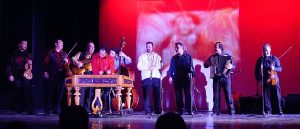
Monday night at Paint Branch Unitarian Church in Adelphi, a packed house of folkies, nostalgic Hungarians and assorted lovers of world music were transported to a landscape of shepherds, Gypsies and three-day wedding celebrations by the stellar Okros Ensemble. Among Hungary’s most soulful and virtuosic folk revival bands, this chamber-size group of string players–two violins, three violas, bass and cimbalom, with legendary Transylvanian violinist Sandor Fodor (known as Neti) and ethereal vocalist Agi Szaloki–tore through a program of csardas, laments, rhapsodies and story-songs so sonorous and emotionally wrenching that one could barely keep one’s hands from clapping or one’s eyes from misting over.
The delights were many. Certainly the 77-year-old Neti, an impish fellow who can play fiendishly quick figures over and over for minutes at a time without missing a note, lent authenticity and spark to the proceedings. But there was also the alternately astringent and lushly romantic sound of Kalman Balogh’s ornately carved cimbalom (the Eastern European equivalent of our hammer dulcimer). And the wonderfully nasal, keening quality of Szaloki’s voice, not to mention this slip of a gal’s delicate dance steps. And the insistent drone of the violas and bass under the violinists’ close harmonies, myriad ornamentations and slightly bent notes. Even the explanations of each selection, by the ensemble’s scholarly leader, Csaba Okros, proved as charming as they were informative.
The concert and dance party that followed, co-sponsored by the Birchmere, were the opening event of the Institute of Musical Traditions concert series. If this evening was typical of the season’s offerings, we can look forward to some ecstatic and enriching music.
Gypsy Roots
Bob Doran
Review of OKROS show in Austin, Texas
Gypsy Roots
Bob Doran
Musicians all around the world are returning to the roots, searching for authentic sources. While an American bluegrass picker might pore over records by an old banjo player, in Hungary the roots go back much further and run much deeper.
The Ökrös Ensemble, leaders in the Hungarian folk revival movement, are touring the United States performing traditional Gypsy music from Transylvania. Monday, Jan. 29, the group visits Arcata’s Veterans Hall for a show presented by Jacaronda Associates and the Humboldt Folklife Society.
The string ensemble is led by violinist, Csaba Ökrös, one of the leaders of the folk revival. Joining Ökrös for the tour is Kálmán Balogh, master of the Gypsy cimbalom, a version of the hammer dulcimer that resembles a small piano with no keys.
In the band’s Gypsy folk tunes, double bass and viola set the rhythm. The cimbalom propels the melody from one dance tune to another with the violins on top sketching jazzy filigrees.
Balogh comes from a long line of Gypsy musicians. He began playing when he was very young, learning from his uncle.
“He showed me first a Romanian dance melody in B minor,” he said. “I was learning very fast and he told my parents I must study, so I went to school to study cimbalom classical way. In school I started to study easy classical pieces, like from Bach, from Mozart, from Haydn. Any music that is possible to play on piano or violin or guitar, we would play on cimbalom.
“Then when I was twelve I started to play folk music in the dance orchestra in Miskolc. This was the original authentic folk music from the village, from Romania and Hungary.
“Perhaps you’ve heard about the dance house movement in Hungary? It was a very powerful movement all over Europe. Everywhere they started to rediscover and study this Hungarian dance house music: the authentic folk music from the village.”
According to Balogh the village music is very different from what most people think of as Gypsy music. “The romantic Gypsy music was popular before that, nobody knew about the folk music from the village. The town music which became very popular in the beginning of this century, that was the romantic style of salon music – you know, the kind of violin crying, sentimental music.
“The village music is more rustic, really it came out of folk music. We found that in the village one can still find the sources for the authentic Gypsy music.”
Ökrös’ other guests on the tour include the Romani fiddler, Csiszar Aladár, from the Szekelyfold region of Hungary. According to Kalman Magyar who organized the tour, “Aladár is the last person practicing this kind of playing from the region – he learned it from the masters. He was part of something called “The Last Hour Project” which recorded all the surviving musicians. It was put together by the director of Ökrös, he discovered this guy.
“This is the last hour when we can find this music in Hungary. This is it. There’s no more after this because people in the village do not want this kind of music, not the young ones. There’s no market for it so it will die out.
“People like Ökrös are the ones who will carry forth this traditional music. And Aladár is one of the guys who will pass the torch, musically speaking, to the new generation like Ökrös who are young musicians, a revival band. They didn’t all grow up in the village you know. The only way you will hear a guy this play is with these young musicians because his musician colleagues are not alive any more.”
Csárdás! Masters of Folk Music from Hungary
BAM Opera House, New York, February 20–21, 1998
Csárdás!–BAM Opera House, New York City, Feb. 20 & 21, 1998
Neti– Folk violin
KálmánBalogh– cimbalom
TheÖkrösFolk Ensemble ofHungary
Robert Spano – conductor
Laura Park – violin
The [Ökrös] musicians could not be any better … Balogh [hammered] with a demonic speed that seemed to rival the piano experiments of Nancarrow.”
As twentieth century composers have been influenced by Indonesian gamelans or African drums, Brahms was one of many nineteenth century composers who found Gypsy charm and fire irresistible. Decades later, the pungent folk music of Hungary &Romania galvanized Bartók and Kodály. For this weekend exploration of the influence of both Gypsy and Hungarian folk music, we present seven astonishing Hungarian Gypsy and folk artists – including, in Neti, a living legend of the Gypsy violin. And we’ll hear folk-influenced music of two of Europe’s most vital contemporary composers – György Kurtág.
Johannes Brahms:Hungarian Dances
Gyorgy Ligeti: Violin Concerto (new York premiere)
Bela Bartok: Music for Strings, Percussion & Celesta
Zoltan Kodaly: Hary Janos Suite
Gypsy & Hungarian folk music
BAM Opera House
February 20 & 21, 1998 at 8pm (pre-concert presentation at 7pm)
Tickets: $35, 27.50, 17.50
Call BAM Ticket Services at: 718 636 4100
Last_Save=”9/18/98 1:41:08 AM”